


Let’s start with a simple reality: There are still a lot of advisors out there who haven’t heard of IRMAA. Or haven’t spent much time thinking about it.
And that’s a problem.
Because IRMAA (Income-Related Monthly Adjustment Amount) isn’t some obscure Medicare detail. It’s something that can directly impact a client’s cash flow in retirement.Yet in many cases, it doesn’t show up in the planning conversation until it’s too late. It shows up as a surprise.
 |
| Jim Dobler, ChFC, RICP, RSSA, IRMAACP, CASL, CAIA Vice President, Retirement Advanced Markets & Planning Ash Brokerage |
A client thinks their income plan is dialed in, and then their Medicare premiums jump. Or an advisor realizes, after the fact, that IRMAA was never part of the strategy.
If that sounds familiar, it’s worth stopping and taking a closer look. Because once you understand how IRMAA actually works, you start to see it everywhere.
Below are six common IRMAA misconceptions and consider how they can affect your clients’ retirement.
1. “IRMAA is a healthcare issue”
I hear this one all the time.
But IRMAA really isn’t a healthcare planning issue, it’s a tax planning issue that shows up as a healthcare cost.
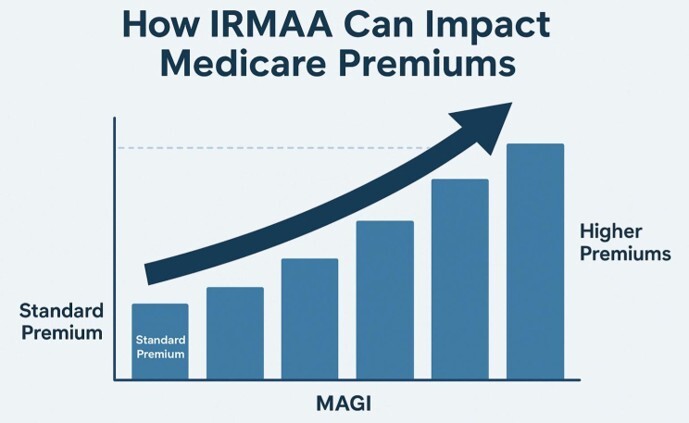
Your client’s Medicare premiums are based on their modified adjusted gross income (MAGI). Which means things like:
- Roth conversions
- Capital gains
- RMDs
- One-time income events
- Interest from Municipal Bonds
All of these and more, can drive IRMAA. So, if IRMAA isn’t part of your tax projections, it’s probably not part of your plan.
2. “We’ll deal with that when they retire”
This is another big one.
IRMAA doesn’t start at retirement; it starts years before retirement planning conversations usually go there.
Because of the two-year lookback 2026 Medicare premiums are based on 2024 income.
So, decisions being made today, while a client is still working or maybe even at peak earnings, are already setting up future IRMAA exposure. By the time you’re reacting to it, the planning window may already be closed.
3. “This only affects wealthy clients”
Not necessarily. In practice, IRMAA hits a lot of mass affluent retirees.
Why? Because income doesn’t always drop the way people expect in retirement:
- RMDs start stacking on top of Social Security
- Portfolios are still generating taxable income
- Married couples may still be filing jointly even after one spouse retires
Before long, they’re over a threshold, and now IRMAA is in play. This is less about wealth, and more about whether it was planned for.
4. “It’s just a small surcharge”
This is where I think a lot of advisors, and clients, really underestimate the impact.
Let’s put real numbers to it. In 2026, the standard Part B premium is about $202.90/month.
But at the highest IRMAA bracket (income of $750k+ for a couple):
- Part B jumps to about $689.90/month per person
- That’s an extra $487/month per person just for Part B
Add a Part D surcharge of about $91/month per person and that’s roughly $578/month in IRMAA surcharges per person
Now here’s the part that often gets missed: IRMAA is per person. So, for a married couple:
- ~$578 × 2 = $1,156 per month in surcharges
- That’s nearly $13,900 per year
- And over just five years? ~$70,000+ in additional premiums
And that’s before factoring in the base premiums they were already paying.
This is why IRMAA isn’t just a “small surcharge.” It behaves a lot more like a stealth tax with cliff effects, where even a small increase in income can trigger a big jump in cost.
5. “Once it happens, there’s nothing we can do”
This one gets missed a lot. IRMAA can be appealed if there’s a qualifying life-changing event.
Things like:
- Retirement
- Death of a spouse
- Divorce
- Loss of income-producing assets
The challenge is that many advisors simply aren’t familiar with the process, so the opportunity gets overlooked. Planning isn’t just about what you do ahead of time. It’s also about knowing when you can respond.
6. “We should always avoid IRMAA”
This is where things get more nuanced. Avoiding IRMAA at all costs isn’t always the right move.
There are plenty of situations where a Roth conversion increases income and triggers IRMAA in the short term. But it also improves long-term tax efficiency and reduces future RMD pressure.
So, the goal isn’t to eliminate IRMAA. It’s to manage it within the bigger picture.
Final Thought
The advisors who create real value here aren’t the ones who simply try to avoid IRMAA. They’re the ones who pause, recognize its impact early, and build it into the conversation from the start.
Because once you do that, you start integrating it into everything else:
- Tax strategy
- Income planning
- Portfolio decisions
- Client cash flow
That’s when surprises go away and better decisions start to show up.
If IRMAA hasn’t been part of your planning process, this is a good moment to change that. Not because it’s complicated. But because it’s too important to overlook.







.webp?width=200&height=30&name=commonwealth%20(1).webp)
%20.png?width=110&height=41&name=b.%20RSSA_Logo_(R)%20.png)
.png?width=200&height=37&name=Eagle_Life_Logo-Blue-2022%20(1).png)



.jpg?width=160&height=33&name=Marshall_Stevens%20(1).jpg)